Prune It or Take It Down? How We Evaluate a Tree Before Deciding
The same defect can call for a different answer depending on structure, decay, roots, and what's underneath the canopy.
September 23, 2026 · 4 min read
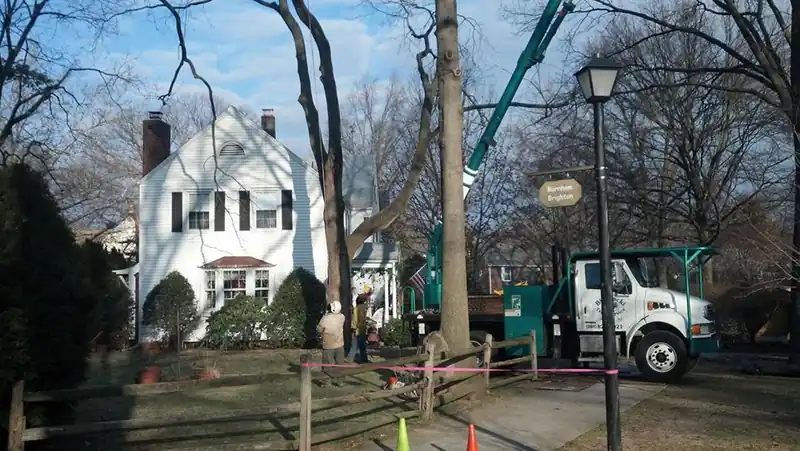
Homeowners ask us this all the time, standing under a tree that looks like it might be more trouble than it's worth: is this a pruning job, or does it need to come down? There's no single answer that applies to every tree. Derek, ISA Certified Arborist #1040A, walks through the same handful of things on every evaluation before making that call. It's rarely a quick glance and a guess. Every tree gets the same structured look before we say anything definitive, because guessing wrong in either direction either costs a homeowner a tree that could have stayed, or leaves a real hazard standing.
Starting With the Tree's Overall Structure
The first thing we look at is how the tree is actually built. A single strong trunk with well spaced branches is a very different starting point than a tree with two or three codominant stems fighting for the same space, especially where those stems meet at a narrow angle with bark pinched between them instead of solid wood. That kind of included bark is a weak point that tends to fail eventually, and how much of the tree's structure depends on that weak point matters a lot to what we recommend. We're also looking at trunk taper, whether the trunk narrows gradually from base to crown the way a well developed tree should, or whether it stays uniform in a way that can signal a weaker root system underneath.
Checking for Deadwood and Decay
Some deadwood is completely normal and just needs to be pruned out. It's a different situation when there's decay working into the trunk itself: cavities, soft or crumbling wood, fungal growth on the bark, or bark that's sloughing off in patches. Deadwood in the canopy is often something we can prune away and move on. Decay established in the trunk or a major limb tells us the tree's structural integrity is compromised in a way pruning alone can't fix.
Looking at What's Happening Below Ground
A tree's stability starts at the root plate, and that's harder to see than anything happening in the canopy. Soil that's started to heave or crack near the base of the trunk, a lean that wasn't always there, or roots that circle back and girdle the trunk instead of growing outward are all signs we're looking at a foundation problem, not a pruning problem. A tree can look perfectly healthy above ground and still be sitting on a compromised root system underneath.
Where the Tree Sits Matters as Much as Its Condition
The same defect calls for a different answer depending on what's underneath the tree. A codominant stem with included bark hanging over open lawn is a different risk than the same structure hanging directly over a roof, a driveway, or where the family parks. We factor in what's under the canopy just as much as the defect itself. A tree with a manageable issue in a low consequence spot often gets pruned. The same issue over a structure people use every day pushes the decision toward removal, because the cost of being wrong is higher there. A tree over open lawn that fails partially still just falls into grass. The same failure over a patio or a bedroom window is a different situation entirely.
When Pruning Solves It
If the core structure is sound, structural pruning, crown reduction, and deadwood removal handle a lot of what looks alarming from the ground. Reducing weight on a long, over extended limb, correcting a lean inducing branch, or clearing dead wood out of the canopy can take real risk off a tree that's otherwise healthy and worth keeping.
When Removal Is the Right Call
Extensive trunk decay, a split at a major branch union, or a root plate that's already started to fail are the kinds of things pruning can't correct. At that point, removal is the safer recommendation, especially if a failure would come down on the house, a driveway, or anywhere people and cars regularly are. It's not the call we lead with, but it's the honest one when the tree's structure doesn't support anything else. We'll always walk through the reasoning with the homeowner rather than just delivering a verdict, because it's their tree and their yard, and the decision should make sense to them, not just to us.
If you've got a tree you're not sure about, we'll come out, walk the whole tree with you, and give you a straight answer on whether it should be pruned or come down. Call Live Oak Tree Service at (201) 337-3616, or visit our tree removals page or our pruning and trimming page to see both sides of that work.
Live Oak Tree Service, (201) 337-3616
Call (201) 337-3616More articles
Why We Never Use Spurs to Prune a Tree We're Keeping
Spurs have a real place in this trade, and it isn't on a tree that's staying in the ground.
A Tree Just Came Down in the Storm: What to Do First
The moments right after a tree comes down matter more than most homeowners expect.