Why We Never Use Spurs to Prune a Tree We're Keeping
Spurs have a real place in this trade, and it isn't on a tree that's staying in the ground.
September 23, 2026 · 3 min read
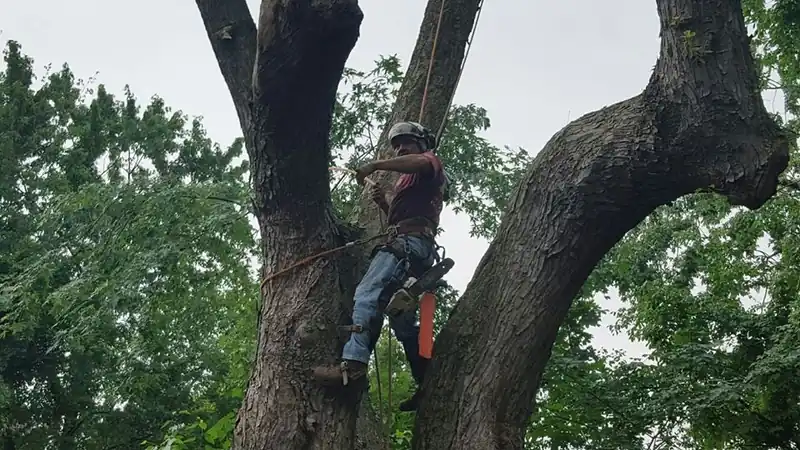
If you've watched a crew climb a tree with metal spikes strapped to their boots, you might assume that's how all tree work gets done. It's not, and if we're pruning a tree you plan to keep, we won't touch it with spurs. Spurs have a real job in this trade. It just isn't pruning.
What Spurs Actually Do to a Tree
Climbing spurs, also called gaffs or spikes, are two curved metal points strapped to the inside of a climber's lower leg. Every step up the trunk, the spur punches through the bark and into the wood underneath. On a tree that's coming down anyway, that doesn't matter much, the whole tree is about to become mulch and firewood. On a tree you want to keep growing, every one of those punctures is a wound that has to heal, and a tree doesn't heal the way skin does. It seals the injury off and grows new wood around it, but the damaged tissue underneath stays there for the life of the tree.
Why That Matters More Than It Looks Like It Does
A single spur wound might look small, barely a scratch through the outer bark. But a pruning job on a mature shade tree can mean climbing sixty or seventy feet, with dozens of steps up the trunk and out along major limbs. Each one of those steps is an opening in the tree's outer defense, right through the bark and cambium layer where the tree actually grows. Insects and decay fungi get in through exactly this kind of wound, and once they're established in the trunk of a tree you're trying to keep healthy, there isn't a treatment that reverses it. The tree just carries that damage for the rest of its life.
How We Climb a Tree We're Pruning Instead
For pruning work, our crew climbs on rope and saddle, using established climbing lines and friction hitches that hold a climber's weight without ever touching the bark with a point. Footlocking, single rope technique, and moving branch to branch on rated climbing line all get a pruner into the canopy without leaving a single puncture wound behind. For a lot of jobs, especially anything within reach of the street or driveway, the bucket truck does the job with no climbing at all. Which method we use depends on the tree's size, its location, and what kind of pruning it needs, but the constant is that a tree staying in the ground never gets spurred.
This Is What ANSI A300 Pruning Standards Are Built Around
Derek follows ANSI A300 pruning standards on every pruning job, the industry standard for how trees should be cut and cared for. Those standards exist because arborists learned this lesson over decades of tree work: a pruning cut should help the tree, not create a second wound worse than the branch you removed. Spur damage on a tree that's staying put runs against that whole idea. It's an old habit some tree services never dropped, mostly because it's faster and lets a climber move without setting ropes. Faster for the crew isn't the same as better for the tree.
- Structural and ornamental pruning to shape a tree as it matures
- Crown reduction and crown elevation, done from rope and saddle or the bucket
- Removal of dead, dying, or diseased branches down to three quarters of an inch
- Young tree pruning to set up good structure for the next twenty years
When We Do Use Spurs
Removals are a different job entirely. If a tree is coming down, climbing with spurs is often the safest and most efficient way to get a climber up a trunk that may already be compromised, especially ahead of a crane pick or when a bucket truck can't reach the site. There's no future growth to protect at that point, so the calculation changes completely. The line for us is simple: if the tree is staying, no spurs. If it's coming down, they're a legitimate tool.
If you've got a tree that needs shaping, deadwood removed, or its crown balanced after years of growth, Live Oak Tree Service prunes it the way that keeps it healthy for the long run. Call us at (201) 337-3616 or take a look at our pruning and trimming page to see the kind of work we do.
Live Oak Tree Service, (201) 337-3616
Call (201) 337-3616More articles
A Tree Just Came Down in the Storm: What to Do First
The moments right after a tree comes down matter more than most homeowners expect.
Deer Ticks in a Bergen County Yard: Where They Fit in Plant Health Care
Tick control isn't a separate errand, it's part of the same visit that keeps your trees and shrubs healthy.